Friday, March 14, 2014


Tuesday, March 4, 2014
How I Learned to Stop Worrying and Love the Robots
A new Financial Times article highlights some of the risks to workers in the rise of technology, the potential to displace workers in nearly all fields. Is this necessarily a bad thing?
The intention of technology is to replace the need for high levels of human labor in a variety of industries. Assembly lines were the first transition toward this consistency and efficiency, such as Henry Ford's example. Before that, the cotton gin freed the slaves before politicians could sort out emancipating them. Today, we have entire automobile factories staffed by humans only in supervisory positions to monitor and maintain the robots that create automobiles. This makes manufacturing processes safer by removing the human from dangerous environments, along with making the goods more consistent from one unit to the next. This frees us up to pursue other interests and hobbies, providing us more leisure time through lower labor demands.
This has fed two visions of the future of work. In one, the machines take on many of the boring parts of a job, setting humans free to supply the more advanced – and satisfying – brain work. The other vision is less harmonious: the machines leave many human workers on the scrap heap altogether.
Or it should. No sympathy for the Luddites. We have to learn new skills to survive in a society that heavily taxes the individual, not fight progress.
The future could be a very optimistic progressive shift toward automated labor, like a science fiction story, if politics didn't get in the way and negate many of those advancements. I think that in the long-run, politics is not able to hold back progress, and technology will give us that freedom from labor, but who knows when that might happen. Looking back into history, this seems to be the trend as well.
It is obvious that physical labor will continue with this trend, but the processing capacity of computers is nearing that of the human brain, and Kurzweil's research suggests that within a generation they will surpass our cognitive abilities. Eventually, artificial intelligence might remove humans from the process entirely, but that is still firmly in the realm of science fiction. In the meantime, the potential for computers to disrupt and displace work that involves research and processing data is highly likely, and has already occurred in some settings. Before AI can be a viable threat, it must pass the Turing test, but eventually technology has the potential to displace almost any human labor. Just hope that the Three Laws are included as standard features, and that they work in real-world applications...
Despite churning out 40 reports a day, he claims the robo-writer, called Quill, was good at disguising its non-human origins: “They changed the grammar and language – you couldn’t tell it was from a computer.” He admits the human writers at his company “freaked out” when they heard he was planning to use the system.
In the design and publishing world, especially in our assessment processes, the demand for human labor is constantly declining. We are constantly looking for ways to automate the products we deliver, and do so at lower costs. In my position, I use technology to automate creation and cleanup of batches of files that in years past were handled manually, one at a time. I am unemploying the designers that I work with every day. I sympathize with them, because many of the skills I learned when I entered printing have become outmoded, many of my previous positions no longer exist. And I believe that someday even what I do now will be automated by computers, but I embrace that potential. I would rather spend my days reading books, exploring the wilderness, and connecting with friends and family than laboring away. Technological unemployment has the potential to bring that life to reality.
Wednesday, February 5, 2014
Vanishing Privacy With Real-Time Facial Recognition
A recet article at the Modern Survival blog brings up the issue of privacy in an increasingly-connected world, technology that recognizes faces in real-time:
The latest is the ‘NameTag’ smartphone or Google Glass app, which enables a person to simply snap a picture of someone (purportedly who you want to connect with) and see their entire public online presence in one place… Everything about you…
Your most unique feature – your face, enables the real-time facial recognition technology to link your face to a single, unified online presence that includes your contact information, social media profiles, interests, and anything else which the app may discover about you based on your electronic footprints of online activities.
When someone passes you on the street (or anywhere), they don’t know who you are – unless they ask or already know. With this new technology they will apparently be able to discover all sorts of things about any stranger by simply pointing their smartphone at them (or apparently when wearing Google Glass or other such technology). So much for asking…
http://modernsurvivalblog.com/communications/vanishing-privacy-with-real-time-facial-recoginition
The idea that technology which can on one hand make the world a smaller place gives reason to be optimistic about the future, but privacy concerns might tarnish those advancements. New technologies need to continue to hold privacy at the front of efforts to digitize the analog world.
The latest is the ‘NameTag’ smartphone or Google Glass app, which enables a person to simply snap a picture of someone (purportedly who you want to connect with) and see their entire public online presence in one place… Everything about you…
Your most unique feature – your face, enables the real-time facial recognition technology to link your face to a single, unified online presence that includes your contact information, social media profiles, interests, and anything else which the app may discover about you based on your electronic footprints of online activities.
When someone passes you on the street (or anywhere), they don’t know who you are – unless they ask or already know. With this new technology they will apparently be able to discover all sorts of things about any stranger by simply pointing their smartphone at them (or apparently when wearing Google Glass or other such technology). So much for asking…
http://modernsurvivalblog.com/communications/vanishing-privacy-with-real-time-facial-recoginition
The idea that technology which can on one hand make the world a smaller place gives reason to be optimistic about the future, but privacy concerns might tarnish those advancements. New technologies need to continue to hold privacy at the front of efforts to digitize the analog world.
Monday, December 23, 2013
Environmental Disasters and Media Manipulation
From an interview by investigative journalist Greg Palast in his book Vulture's Picnic, in which we find that most scientists who supported the idea that the ocean cleaned up after BP oil spills is mostly false, and most of those biologists who support the idea were paid by BP itself as an effort to manipulate the population through media outlets like NPR...
"Now, without shame, BP and the Interior Department are using this same “Bugs Ate the Oil” stunt in the Gulf. They added a twist. Maybe it didn’t work perfectly in cold Alaska, but bacteria just love Mississippi.
This Mississippi island was impressively oiled, but I wasn’t impressed. Something was missing.
Habeus corpus picis? Where are the fish corpses, Professor?
In the water, Steiner explained. While we would see a couple of oil-packed fish carcasses on the beach, the big slaughter is actually going on way out there, in the fishing grounds and beyond.
The killer: BP, that is, Bacterial Plumes.
Steiner told me that bacteria were indeed eating up some of the hydrocarbon from the blowout, “but mostly the methane, not the heavy crude.” Bacteria certainly munch on some of it (good), which encourages bacteria to make bacterium babies by the trillions (bad). As the bacteria feast, said Steiner, they breathe, as all creatures do. The result: not much oxygen left in the water for fish. The fish can’t breathe and they drown."
"Now, without shame, BP and the Interior Department are using this same “Bugs Ate the Oil” stunt in the Gulf. They added a twist. Maybe it didn’t work perfectly in cold Alaska, but bacteria just love Mississippi.
This Mississippi island was impressively oiled, but I wasn’t impressed. Something was missing.
Habeus corpus picis? Where are the fish corpses, Professor?
In the water, Steiner explained. While we would see a couple of oil-packed fish carcasses on the beach, the big slaughter is actually going on way out there, in the fishing grounds and beyond.
The killer: BP, that is, Bacterial Plumes.
Steiner told me that bacteria were indeed eating up some of the hydrocarbon from the blowout, “but mostly the methane, not the heavy crude.” Bacteria certainly munch on some of it (good), which encourages bacteria to make bacterium babies by the trillions (bad). As the bacteria feast, said Steiner, they breathe, as all creatures do. The result: not much oxygen left in the water for fish. The fish can’t breathe and they drown."
Wednesday, November 20, 2013
The Neurogrid Artificial Brain
Inspired by GRAPE-6, a $60K supercomputer that has revolutionized astrophysics, Neurogrid provides an affordable option for brain simulations. It uses analog computation to emulate ion-channel activity and uses digital communication to softwire synaptic connections. These technologies impose different constraints, because they operate in parallel and in serial, respectively. Analog computation constrains the number of distinct ion-channel populations that can be simulated—unlike digital computation, which simply takes longer to run bigger simulations. Digital communication constrains the number of synaptic connections that can be activated per second—unlike analog communication, which simply sums additional inputs onto the same wire. Working within these constraints, Neurogrid achieves its goal of simulating multiple cortical areas in real-time by making judicious choices.
http://www.stanford.edu/group/brainsinsilicon/neurogrid.html
Could a computer capable of greater processing capacity than the human brain in a smaller package replace our own minds? If those computers became self-aware...
http://www.stanford.edu/group/brainsinsilicon/neurogrid.html
Could a computer capable of greater processing capacity than the human brain in a smaller package replace our own minds? If those computers became self-aware...
Sunday, November 17, 2013
Comet ISON Now Visible to Naked Eye After Cosmic Outburst
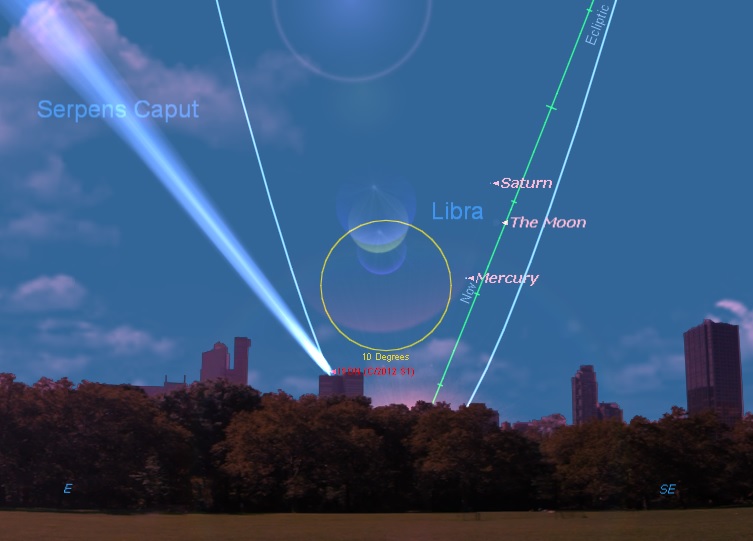
Next Monday morning (Nov. 18), ISON will be passing close to the bright 1st magnitude star Spica in Virgo. Using the handle of the Big Dipper, sweep an arc to the brilliant orange star Arcturus. Then continue that arc on to Spica. Using binoculars, ISON should still be readily be visible as a fuzzy star with a short tail.More: Comet ISON Now Visible to Naked Eye After Cosmic Outburst
Look to ESE over the next few days to spot the comet near the ecliptic. Follow the latest Comet ISON news at Space.com.
Sunday, November 10, 2013
An Out-Of-Control Satellite Is Plummeting To Earth Right Now

A European gravity-mapping satellite has begun its uncontrolled descent through the atmosphere, and there's a (incredibly minuscule) chance it could land on your head.
http://feedproxy.google.com/~r/jalopnik/full/~3/vsjU87uz4l8/@ballaban
My question is whether I get to keep if it lands on my property.

Subscribe to:
Posts (Atom)