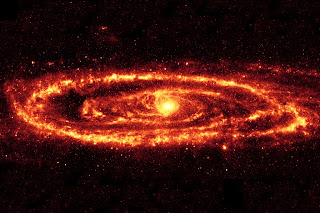
http://www.sott.net/article/255353-Approaching-comet-may-outshine-the-moon
A comet which will pass the Earth November 2013 may be brighter than our own moon.
http://www.sott.net/article/255353-Approaching-comet-may-outshine-the-moon
A comet which will pass the Earth November 2013 may be brighter than our own moon.

Like dust bunnies that lurk in corners and under beds, surprisingly complex loops and blobs of cosmic dust lie hidden in the giant elliptical galaxy NGC 1316. This image made from data obtained with the NASA/ESA Hubble Space Telescope reveals the dust lanes and star clusters of this giant galaxy that give evidence that it was formed from a past merger of two gas-rich galaxies.

Lyra was above me when summer brought its heat to Texas, but she's hovering near the horizon now. And trees all around doesn't help much...

NGC 2264 is the designation number of the New General Catalogue that identifies two astronomical objects as a single object: -the Cone Nebula, -the Christmas Tree Cluster, Two other objects are within this designation but not officially included: -Snowflake Cluster, -the Fox Fur Nebula. All of the objects are located in the Monoceros constellation and are located about 800 parsecs or 2600 light-years from Earth. NGC 2264 is sometimes referred to as the Christmas Tree Cluster and the Cone Nebula. However, the designation of NGC 2264 in the New General Catalogue refers to both objects and not the cluster alone.


This infrared image from NASA's Spitzer Space Telescope shows the nebula nicknamed "the Dragonfish." This turbulent region, jam-packed with stars, is home to some of the most luminous massive stars in our Milky Way galaxy. It is located approximately 30,000 light-years away in the Crux constellation. The massive stars have blown a bubble in the gas and dust, carving out a shell of more than 100 light-years across (seen in lower, central part of image). This shell forms the "toothy mouth" of the Dragonfish, and the two bright spots make it up its beady eyes. The infrared light in this region is coming from the gas and dust that are being heated up by the unseen central cluster of massive stars. The bright spots along the shell, including the "eyes," are possible smaller regions of newly formed stars, triggered by the compression of the gas and dust by winds from the central, massive stars.

The aftershock of a stellar explosion rippling through space is captured in this new view of the supernova remnant called W44. The image combines longer-wavelength infrared and X-ray light captured by the European Space Agency's Herschel and XMM-Newton space observatories.

The Eagle Nebula (catalogued as Messier 16 or M16, and as NGC 6611) is a young open cluster of stars in the constellation Serpens, discovered by Jean-Philippe de Cheseaux in 1745-46.

IC 443 (also known as the Jellyfish Nebula and Sharpless 248 (Sh2-248)) is a Galactic supernova remnant (SNR) in the constellation Gemini. On the plan of the sky, it is located near the star Eta Geminorum. Its distance is roughly 5,000 light years from Earth. IC 443 may be the remains of a supernova that occurred 3,000 - 30,000 years ago. The same supernova event likely created the neutron star CXOU J061705.3+222127, the collapsed remnant of the stellar core. IC 443 is one of the best-studied cases of supernova remnants interacting with surrounding molecular clouds.

This image from ESO's La Silla Observatory shows part of a stellar nursery nicknamed the Seagull Nebula. This cloud of gas, known as Sh 2-292, RCW 2 and Gum 1, seems to form the head of the seagull and glows brightly due to the energetic radiation from a very hot young star lurking at its heart. The detailed view was produced by the Wide Field Imager on the MPG/ESO 2.2-metre telescope. Credit: ESO. Tap © to visit the web site.
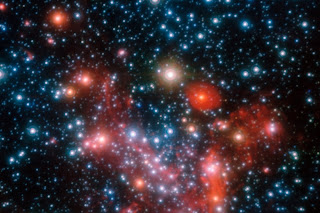
The central parts of our Galaxy, the Milky Way, as observed in the near-infrared with the NACO instrument on ESO's Very Large Telescope. By following the motions of the most central stars over more than 16 years, astronomers were able to determine the mass of the supermassive black hole that lurks there.

The Dumbbell Nebula (also known as Apple Core Nebula, Messier 27, or NGC 6853) is a planetary nebula in the constellation Vulpecula, at a distance of about 1,360 light years. This object was the first planetary nebula to be discovered by Charles Messier in 1764. At its brightness of visual magnitude 7.5 and its diameter of about 8 arcminutes, it is easily visible in binoculars, and a popular observing target in amateur telescopes.

The Milky Way and other galaxies in the universe harbor many young star clusters and associations that each contain hundreds to thousands of hot, massive, young stars known as O and B stars. The star cluster Cygnus OB2 contains more than 60 O-type stars and about a thousand B-type stars. Deep observations with NASA's Chandra X-ray Observatory have been used to detect the X-ray emission from the hot outer atmospheres, or coronas, of young stars in the cluster and to probe how these fascinating star factories form and evolve. About 1,700 X-ray sources were detected, including about 1,450 thought to be stars in the cluster. In this image, X-rays from Chandra (blue) have been combined with infrared data from NASA's Spitzer Space Telescope (red) and optical data from the Isaac Newton Telescope (orange). [...]
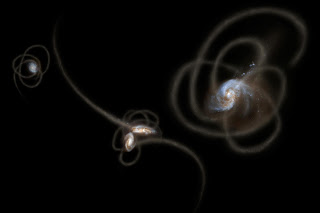
PIA16216: Spitzer Sees Stray Starlight (Artist's Concept) New research from scientists using NASA's Spitzer Space Telescope suggests that a mysterious infrared glow across our whole sky is coming from stray stars torn from galaxies. When galaxies grow, they merge and become gravitationally tangled in a violent process that results in streams of stars being ripped away from the galaxies. Such streams, called tidal tails, can be seen in this artist's concept.

Observations using the Atacama Large Millimeter/submillimeter Array (ALMA) have revealed an unexpected spiral structure in the material around the old star R Sculptoris. This feature has never been seen before and is probably caused by a hidden companion star orbiting the star. This slice through the new ALMA data reveals the shell around the star, which shows up as the outer circular ring, as well as a very clear spiral structure in the inner material. Credit:ALMA (ESO/NAOJ/NRAO)/M. Maercker et al.

A dying star is throwing a cosmic tantrum in this combined image from NASA's Spitzer Space Telescope and the Galaxy Evolution Explorer (GALEX), which NASA has lent to the California Institute of Technology in Pasadena. In death, the star's dusty outer layers are unraveling into space, glowing from the intense ultraviolet radiation being pumped out by the hot stellar core. This object, called the Helix nebula, lies 650 light-years away, in the constellation of Aquarius. [...]

This artist's impression shows the exoplanet Tau Boötis b. This was one of the first exoplanets to be discovered back in 1996, and it is still one of the closest planetary systems known to date. Astronomers using ESO's Very Large Telescope have now caught and studied the faint light from the planet Tau Boötis b for the first time. By employing a clever observational trick the team find that the planet's atmosphere seems to be cooler higher up, the opposite of what was expected. Credit: ESO/L. Calçada. Tap © to visit the web site.
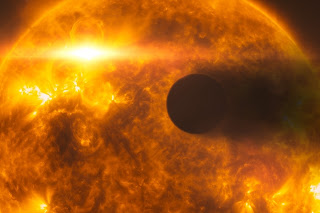
This artist's impression shows exoplanet HD 189733b, as it passes in front of its parent star, called HD 189733A. Hubble's instruments observed the system in 2010, and in 2011 following a large flare from the star (depicted in the image). Following the flare, Hubble observed the planet's atmosphere evaporating at a rate of over 1000 tonnes per second. In this picture, the surface of the star, which is around 80% the mass of the Sun, is based on observations of the Sun from the Solar Dynamics Observatory. Credit: NASA, ESA, L. Calçada. Tap © to visit the web site.Find more pictures and learn more about the Universe in Star Walk app for iPhone and in Star Walk app for iPad
There's some topics on Astronomy Cast that we wait until we are good and ready, until the science is all in. The Dawn mission has completed it's mapping operations at asteroid Vesta and it's now moving on to Ceres. This gives us a great opportunity to take a detailed look at this amazing asteroid, report on the science findings, and give you a preview of what's coming next.
Original Page: http://www.astronomycast.com/2012/10/ep-274-vesta/